
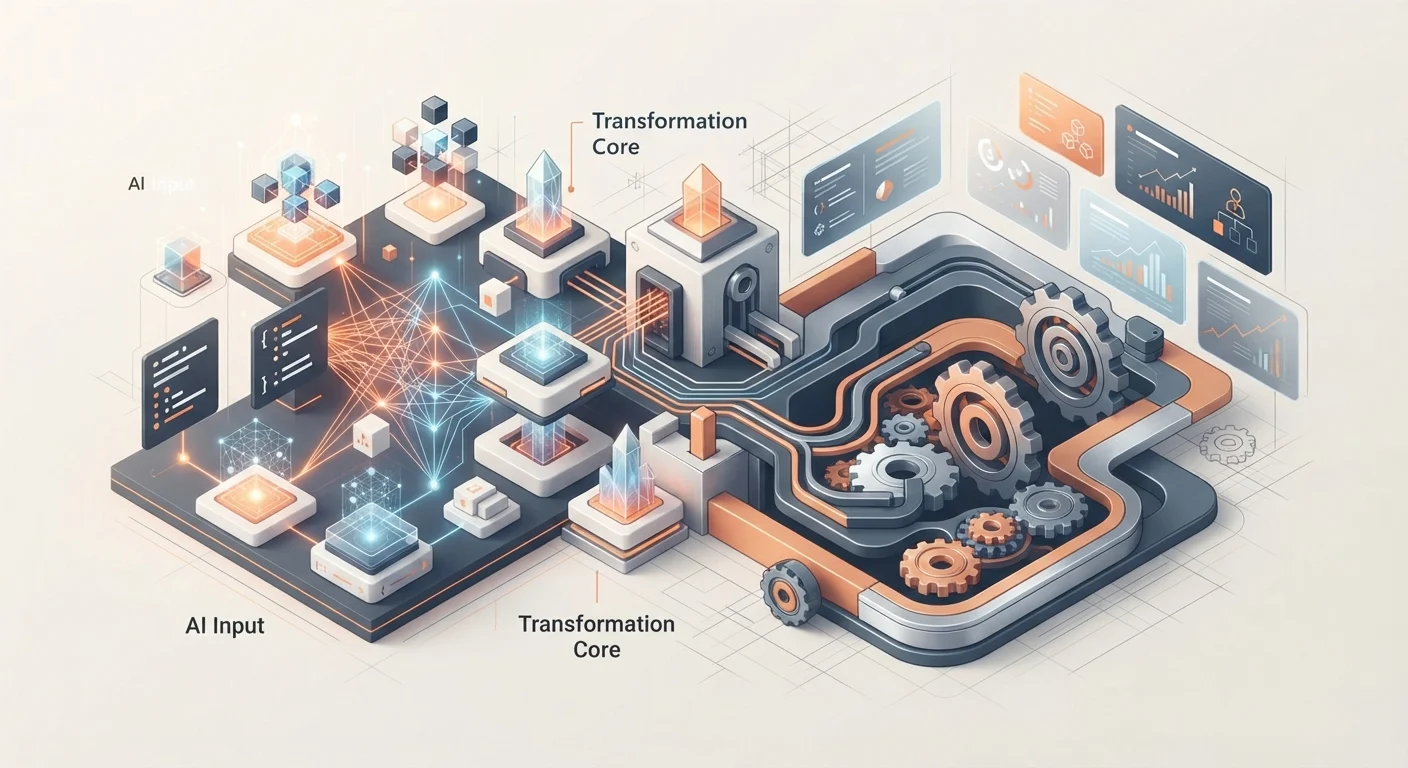
10 AI trends in 2026 center on autonomous agentic systems, multimodal models, inference-time reasoning, small language models, enterprise RAG, low-latency voice, AI software engineering, physical robotics, governance, and cost deflation, moving businesses from basic chat assistants to fully integrated operational executors.
This guide is written for modern enterprise leaders, product managers, and operations teams who need to separate functional artificial intelligence shifts from marketing noise. You will learn how to evaluate technological updates, deploy efficient workflows, and operationalize the ten dominant shifts shaping modern organizations.
By the end of this blueprint, you will possess a structured implementation framework, clear cost-versus-latency decision matrices, and ready-to-copy prompts to test each trend directly inside your team workflows. Use our prompt library to explore further execution templates as you scale your infrastructure.
Key takeaways
- Autonomous multi-agent systems now handle complex, multi-step tasks with minimal human supervision.
- Open-weight convergence and model cost deflation are drastically lowering enterprise deployment expenses.
- Specialized frameworks like RAG and small language models protect corporate data while reducing latency.
- Structured governance and clear implementation roadmaps prevent shadow AI risks and operational bottlenecks.
Executive Summary: The Shift from Chatbots to Autonomous Systems
Modern artificial intelligence is transitioning rapidly from simple conversational chatbots to autonomous systems capable of executing complex workflows independently. Enterprise focus has shifted toward tools that do not merely answer questions, but plan, execute, and verify tasks across multiple software environments.
Evaluating technical utility requires looking past superficial benchmark claims to measure actual task completion rates, cost per output, and integration overhead. Organizations must focus on deployments that solve specific operational bottlenecks rather than adopting tools based purely on novelty. Check the latest developments via AI news to stay informed on enterprise capability updates.
The Macro Trends Defining Modern AI
The dominant technological wave centers on self-correcting execution loops, local edge execution, and multi-modal integration. Hardware cost reductions allow smaller businesses to run powerful local models without relying entirely on expensive cloud APIs.
How to Evaluate AI Hype vs. Measurable Utility
Real utility is measured by reduction in manual processing time and error rates rather than conversational fluency. Teams should run strict pilot phases with defined key performance indicators before committing capital to foundational model architectures.
1. Autonomous Agentic AI and Multi-Agent Orchestration
Agentic AI systems have shifted from basic conversational copilots to autonomous actors capable of handling multi-step tasks with minimal human intervention medium.com. Instead of writing a single prompt for a single output, developers deploy multi-agent networks where specialized models act as researchers, writers, and reviewers.
These systems operate in closed loops, checking their own work and correcting errors before delivering a final result to a human supervisor. Managing these loops requires strict constraints to prevent agents from entering infinite execution cycles or consuming excessive compute tokens.
Worked Example: Multi-Agent Competitor Intelligence Workflow
An analyst agent searches public web data for competitor pricing changes. A strategist agent evaluates the findings against your internal product catalog. A formatting agent compiles the final report into a structured dashboard for executive review.
Common Implementation Traps in Agentic Loops
Failing to set maximum step limits causes runaway API costs and infinite loops. Always define explicit exit criteria and human checkpoints for any action involving external communications or financial transactions.
Act as an enterprise research orchestrator. Analyze the following target market: [TARGET_MARKET]. Execute a 3-step investigation: 1) Identify top 3 competitors and their pricing models, 2) Highlight key feature gaps based on recent customer complaints, 3) Draft a strategic summary for the [TARGET_DEPARTMENT] team. Output the result in structured markdown format with explicit confidence scores for each data point.
2. Inference-Time Reasoning and Test-Time Compute
Inference-time reasoning allows models to deliberate, test hypotheses, and evaluate multiple logical paths before generating a final response. Rather than relying solely on pre-training scale, these architectures dedicate extra compute at runtime to solve complex mathematical or logical problems.
Choosing between standard large language models and reasoning models depends entirely on the nature of your task. Standard models excel at fast classification, summarization, and tone adjustment, while reasoning models are essential for code architecture, financial auditing, and advanced data analysis.
Pre-training Scaling vs. Inference-Time Deliberation
Pre-training scaling expands the static knowledge stored within neural network weights. Inference-time compute uses dynamic token generation to 'think' through multi-step logic puzzles before outputting text.
When to Choose Reasoning Models vs. Standard LLMs
Deploy standard models for high-throughput, latency-sensitive tasks like customer chat triage. Reserve reasoning models for high-stakes decisions where logical verification outweighs speed.
Analyze the following business problem: [BUSINESS_PROBLEM]. Before providing a final recommendation, generate three distinct strategic hypotheses. Evaluate the risks, resource requirements, and potential failure modes of each hypothesis in a step-by-step reasoning chain. Conclude with the single most resilient path forward.
3. Omni-Multimodal Generation and Vision-Language-Action Models
Modern multimodal architectures process native video, audio, code, and text simultaneously without converting files into intermediate text formats. This native understanding allows systems to watch a software tutorial or a machinery walkthrough and extract actionable process steps directly.
Bridging creative media and operational data enables teams to automate quality assurance on physical assembly lines or generate localized training videos from text specifications. Use tools like the video to prompt extractor to dissect visual assets for multimodal ingestion workflows.
Real-Time Video and Audio Understanding
Systems can now track spatial changes across hours of surveillance or meeting footage, identifying key moments without manual time-code tagging. This capability transforms passive media archives into searchable, queryable databases.
Bridging Creative Media and Operational Data
Operations managers can feed raw equipment footage into multimodal models to detect wear patterns and operational anomalies instantly. Pair these capabilities with the image to prompt utility to standardize visual inputs across departments.
4. Small Language Models (SLMs) and Edge Computing
Small language models with under ten billion parameters provide enterprise teams with cost-effective, highly specialized utility tools that run locally on standard hardware. Info-Tech's software outlook highlighted AI-assisted coding and small internal utility tools as core practical enterprise opportunities telcoict.com.au.
Running models locally on edge devices ensures absolute data privacy because sensitive customer information never leaves corporate infrastructure. Evaluate model compatibility across your device fleet using our AI model picker to optimize local hardware performance.
Cost-Efficiency Benchmarks: SLMs vs. Frontier Models
Small language models reduce inference costs by over ninety percent compared to frontier cloud APIs while maintaining high accuracy on domain-specific tasks. Fine-tuning an SLM on internal company documentation often yields better retrieval results than querying a generic massive model.
Local Deployment Options and Device-Level Privacy
Edge deployment allows field service technicians and remote workers to access intelligent diagnostic assistants without an active internet connection. This architecture eliminates cloud data transfer fees and complies with strict regional privacy mandates.
5. Context-Rich Enterprise RAG and Memory Grounding
Retrieval-augmented generation grounds model outputs in verified enterprise databases, minimizing hallucinations and ensuring factual accuracy. Modern architectures pair traditional vector embeddings with knowledge graphs to capture both semantic similarity and explicit entity relationships.
Managing long-context retrieval degradation, often called 'lost in the middle', requires careful chunking strategies and re-ranking mechanisms. Ensure your retrieval pipelines are optimized by testing prompts against various database structures using the prompt improver.
Hybrid Search: Vector Embeddings Meets Knowledge Graphs
Vector search finds conceptually similar paragraphs, while knowledge graphs map explicit connections between people, products, and policies. Combining both methods ensures queries retrieve precise facts rather than vague approximations.
Managing Long-Context Retrieval Degradation
Models processing millions of tokens can miss crucial facts buried in the center of massive documents. Mitigate this by placing critical source documents at the very beginning or end of the prompt context window.
6. Ultra-Low-Latency Conversational Voice Agents
Native speech-to-speech models process auditory inputs and generate spoken responses directly, bypassing the lag associated with traditional cascaded transcription and text synthesis pipelines. Voice-capable multimodal systems require structured escalation frameworks, fallback routing, and strict limits on autonomous customer interactions telcoict.com.au.
Structuring voice prompts requires accounting for natural interruptions, filler words, and emotional tone control. These interfaces enable fluid, human-like customer service interactions without the robotic delays of older interactive voice response systems.
Native Speech-to-Speech vs. Cascaded STT-LLM-TTS
Cascaded pipelines convert speech to text, run through an LLM, and synthesize speech back, creating noticeable conversational latency. Native speech models process audio waveforms directly, reducing response times to conversational speeds.
Structuring Voice Prompts for Interruption and Tone Control
Voice prompts must instruct the model to keep responses concise, acknowledge user interruptions gracefully, and adopt a professional, calm vocal demeanor suitable for customer support environments.
7. AI-Assisted Software Engineering and 'Vibe Coding'
Software development has evolved past simple autocomplete extensions into repository-aware agentic coding systems that generate, test, and debug entire feature sets. Developers now act more as architectural reviewers and directors, guiding models through complex codebase transformations.
Architecting safe guardrails for machine-generated code requires automated test suites, static analysis tools, and mandatory human code reviews. Explore our AI models guide to select the right coding assistant models for your engineering stack.
Beyond Autocomplete: Repository-Aware Agentic Coding
Modern coding agents ingest entire code repositories to understand dependency trees, design patterns, and internal style guides before proposing code modifications. This holistic awareness reduces integration bugs and breaking changes.
Architecting Safe Guardrails for Machine-Generated Code
Every block of generated code must pass automated unit tests and security vulnerability scans before merging into production branches. Establish clear policies on intellectual property compliance for open-source code snippets suggested by models.
8. Physical AI, Robotics, and Spatial Intelligence
Physical artificial intelligence combines vision-language-action foundation models with robotic hardware to automate complex physical manipulation tasks. Industrial automation now relies on spatial sensor grounding to allow robotic arms and autonomous mobile robots to navigate unpredictable warehouse environments.
These systems translate high-level natural language instructions into precise physical movements, adapting in real time to obstacles and structural changes. Spatial intelligence bridges the gap between digital software logic and physical real-world operations.
Foundation Models for Robotics (Vision-Language-Action)
Vision-language-action models allow robots to interpret visual scenes and execute physical manipulation tasks without manual programming for every single movement. This flexibility accelerates robotics deployment across manufacturing and logistics sectors.
Industrial Automation and Spatial Sensor Grounding
Sensors provide continuous 3D mapping data that foundation models use to calculate safe gripping forces and navigation trajectories. This integration minimizes equipment damage and improves throughput in high-volume supply chain hubs.
9. AI Governance, Shadow AI Mitigation, and Provenance
Enterprise adoption requires rigorous governance frameworks to prevent data leakage, intellectual property violations, and unauthorized tool usage. Specialized enterprise certifications, including IAPP Certified AI Governance Professional (AIGP) and DeepLearning.AI's RAG track, emerged as key industry benchmarks for operational compliance and LLMOps pragatisoftwaresolutions.com.
Mitigating shadow AI requires providing approved, secure internal alternatives so employees do not paste sensitive company data into consumer-grade tools. Establish clear usage policies and track all model deployments through centralized AI tools directories.
Mitigating Data Leakage and Intellectual Property Risks
Organizations must prohibit employees from using consumer AI accounts with data retention enabled. Deploy enterprise-tier API endpoints with zero data retention policies and strict access control lists.
Establishing Internal AI Acceptable Use Policies
Acceptable use policies must explicitly define which tasks require human review, which data classifications are banned from AI processing, and how prompt logs are audited for compliance.
10. Model Cost Deflation and Open-Weight Convergence
Open-source frontier models, notably led by developers in China, have drastically driven down inference and implementation costs for businesses medium.com. This cost deflation allows organizations to experiment freely and deploy models locally without fear of runaway API subscription expenses.
Calculating total cost of ownership involves evaluating compute infrastructure, fine-tuning expenses, maintenance overhead, and latency trade-offs against proprietary vendor lock-in. Track your operational expenditure using the token and cost calculator to forecast infrastructure budgets accurately.
Calculating True Total Cost of Ownership (TCO)
Evaluating TCO requires looking beyond per-token API prices to include hosting hardware, engineering maintenance, and model evaluation overhead. Open-weight models often lower long-term costs for high-volume enterprise workloads.
Open-Weights vs. Proprietary API Vendor Lock-In
Relying entirely on proprietary cloud vendors creates vulnerability to sudden price hikes and service deprecations. Adopting open-weight models grants organizations sovereign control over their infrastructure and model weights.
Strategic Implementation Matrix: Which Trend Should You Adopt First?
Adopting all ten trends simultaneously leads to organizational fatigue and wasted capital. Organizations must prioritize deployment based on team size, technical maturity, and immediate ROI potential.
The 90-day enterprise AI adoption roadmap starts with secure RAG implementation, moves to small language model automation, and scales into agentic workflows only after baseline data governance is established. Avoid common failure modes by enforcing strict human oversight during early pilot phases.
The 90-Day Enterprise AI Adoption Roadmap
Days 1 to 30 focus on governance, acceptable use policies, and securing enterprise RAG pipelines. Days 31 to 60 involve deploying small language models for internal productivity tasks. Days 61 to 90 pilot multi-agent orchestration for specific operational workflows.
Top Failure Modes and How to Avoid Them
The most common failure is treating AI as a plug-and-play software upgrade rather than a process re-engineering project. Always align AI pilots with measurable business metrics and maintain human-in-the-loop validation for critical decisions.
| Model Architecture | Avg Cost per 1M Tokens | Latency Profile | Recommended Enterprise Use Case |
|---|---|---|---|
| Frontier Reasoning Models | $15.00 – $30.00 | High (Seconds to Minutes) | Complex financial auditing, advanced code architecture, legal reasoning |
| Standard Cloud LLMs | $2.00 – $5.00 | Moderate (Sub-second) | General customer triage, content drafting, data summarization |
| Small Language Models (SLMs) | $0.10 – $0.50 | Ultra-Low (Edge speed) | Local data processing, offline diagnostics, automated ticket classification |
| Native Voice Models | $5.00 – $12.00 | Real-Time (Streaming) | Interactive customer support, voice assistants, real-time translation |
Common mistakes (and what to do instead)
- Treating AI as a simple software upgrade rather than an operational transformation process. Always redesign underlying workflows before introducing automation.
- Ignoring data governance and allowing employees to paste sensitive corporate data into consumer-grade tools. Deploy secure, zero-retention enterprise endpoints immediately.
- Deploying autonomous multi-agent loops without strict step limits or human checkpoints. Always enforce maximum iteration caps to prevent runaway compute costs.
- Failing to measure baseline productivity metrics before rolling out new AI tools. Establish clear key performance indicators to prove return on investment.
Our take
Success in modern enterprise artificial intelligence requires moving past superficial chatbot experimentation to embrace rigorous governance, cost-effective small language models, and structured agentic workflows. Focus your capital on solutions that solve concrete operational bottlenecks while maintaining strict oversight of your data architecture.
Questions people ask
What are the top AI trends in 2026?
Top AI trends in 2026 center on autonomous agentic systems, multimodal models, inference-time reasoning, small language models, enterprise RAG, low-latency voice, AI software engineering, physical robotics, governance, and cost deflation.
What is agentic AI and why is it trending?
Agentic AI refers to systems that execute multi-step tasks autonomously with minimal human supervision. It is trending because it shifts artificial intelligence from answering simple prompts to executing complete end-to-end business workflows.
What are small language models and edge AI?
Small language models are compact AI models with under ten billion parameters designed to run efficiently on local hardware or edge devices, offering superior data privacy and drastically lower operational costs.
How is AI transforming software development cycles?
AI transforms software development through repository-aware coding agents that generate, test, and debug complex feature sets, allowing engineers to focus on architecture and quality review.
Can sensitive corporate data be safely fed into modern LLMs?
Yes, sensitive data can be processed safely if organizations use enterprise-tier API endpoints with zero data retention policies, secure RAG pipelines, or locally deployed small language models.
What are the best AI certifications to learn modern trends?
Industry benchmarks include the IAPP Certified AI Governance Professional (AIGP) credential for compliance and specialized technical tracks focused on RAG architecture and LLMOps.
Sources
- telcoict.com.auUsed for: Voice-capable multimodal systems require structured escalation frameworks [1]Report
- medium.comUsed for: Agentic AI systems shifting from conversational copilots to autonomous actors [2]Report
- pragatisoftwaresolutions.comUsed for: Specialized enterprise certifications including IAPP AIGP emerged as key benchmarks [3]Report
Facts checked . We update this story when details change.
Written with AI assistance from the sources above and checked against them before publishing. Spotted an error? Tell us and we will fix it.
How we made this guide: we read the pages that rank for "10 ai trends in", mapped every subtopic and question they answer, added what they were missing, and checked the facts against the sources above.