
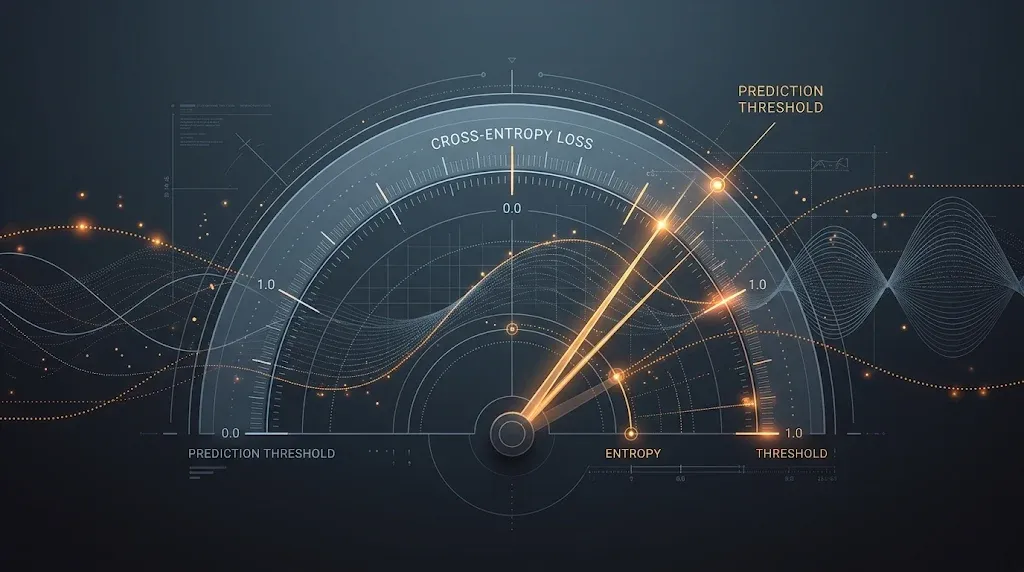
OpenAI Chief Scientist Jakub Pachocki has proposed using the perplexity metric as a shared industry standard to track base model progress and enforce developmental pacing limits. The plan asks frontier labs to commit to pausing training past specific prediction loss thresholds until monitoring techniques catch up with emergent capabilities [1].
You likely notice that frontier AI tools do not improve in smooth, predictable increments. Instead, models jump forward unpredictably, suddenly solving advanced code or multi-step logic problems that earlier versions failed completely.
OpenAI has now made public the internal yardstick it uses to track these leaps across generations. In an essay titled "Perplexity and Intelligence," Chief Scientist Jakub Pachocki argues that the perplexity metric is the single most reliable signal for emergent capabilities [1].
Below, we unpack how prediction loss tracks raw capability, why OpenAI is urging competitors to accept a developmental pause, and what this proposal means for the future tools you rely on.
Key takeaways
- Perplexity tracks next-token prediction accuracy, with lower numbers signaling higher latent capabilities [1].
- OpenAI proposes industry-wide development limits below roughly 0.71 log-perplexity until monitoring tools advance [2].
- Major capabilities in cybersecurity and mathematics emerged rapidly as pretraining loss fell below 0.8 [1].
- The proposal is a technical policy framework for model builders, not a consumer feature update [2].
How OpenAI uses the perplexity metric to measure intelligence
OpenAI frames modern model creation as training a data compressor to predict the next token across massive text collections [1]. The primary diagnostic for this process is cross-entropy loss, commonly expressed as the perplexity metric, where lower values represent superior compression and sharper prediction [1]. According to Hacker News, this foundational compression score has directly correlated with qualitative jumps across every release since GPT-2 [1].
Past milestones illustrate how specific numeric drops unlock unprompted skills. GPT-3.5 reached a log-perplexity of roughly 0.99 on OpenAI's evaluation set to enable sustained chat, while GPT-4 hit approximately 0.91 and demonstrated effective chain-of-thought problem solving [1]. When internal models crossed below the 0.8 mark, unexpected competencies surfaced in technical domains such as cybersecurity [1]. Models scoring around 0.76 resolved longstanding open mathematical problems directly inside internal researcher discussions [1]. Reviewing our AI models guide helps put these generational jumps into context.
Downstream benchmarks like MMLU inevitably saturate, but raw pretraining loss continues to track underlying capacity over time [1]. Because these capabilities surface without being explicitly designed into the training run, compression performance serves as the primary early warning sign for latent model behaviors before fine-tuning occurs [1].
I believe tracking the pace of progress on training better compressors is key to understanding the arc of advances in AI.
Jakub Pachocki, Chief Scientist at OpenAI
At a glance
| Detail | What we know |
|---|---|
| Who | Jakub Pachocki, Chief Scientist at OpenAI [1] |
| What | Technical essay and policy framework titled 'Perplexity and Intelligence' [2] |
| Proposed Limit | A threshold band below ~0.71 on OpenAI's held-out perplexity scale [2] |
| Current Internal Model | Sitting at ~0.73 log-perplexity [2] |
| Price | Free / Publicly accessible essay [2] |
| Key Metric | Log-perplexity (or cross-entropy loss) [1] |
| Goal | Establish shared industry norms for evaluating and pacing frontier models [1] |
Why OpenAI wants an industry speed limit
OpenAI is using its historical data to lobby competing frontier labs for enforceable development pacing bars [1]. As models automate their own development cycles, automated algorithmic research on pretraining could compress years of architectural iteration into sudden bursts [1]. According to Hacker News, that positive feedback loop could trigger an avalanche of training advancements as early as 2027 [1].
To prevent model capabilities from outpacing oversight techniques, Pachocki proposes establishing a shared threshold below roughly 0.71 log-perplexity that developers commit not to cross until successor monitoring systems exist [2]. Current alignment checks and chain-of-thought audits begin degrading against advanced models, creating severe blind spots if raw intelligence scales unchecked [1]. A shared ceiling would force developers to pause and prove their auditing instruments work before resuming large-scale pretraining runs [1].
This framework marks a pivot away from hardware-based regulations like counting training FLOPs [2]. Rather than monitoring server clusters, the standard focuses on the resulting intelligence substrate itself [1]. However, according to cellcog.ai, neither Google DeepMind nor Anthropic has formally agreed to standardize their internal loss metrics or submit to coordinated pacing thresholds [2].
AI safety targets focused on vague capabilities or counting hardware compute power.
OpenAI proposes binding safety limits pegged to numerical prediction loss scores.
Future base model releases may be intentionally delayed until safety monitoring tools advance.
0.71
0.71 is the log-perplexity threshold OpenAI suggests labs should not cross without better monitoring tools [2].
- Whether competing labs like Anthropic or Google DeepMind will adopt the framework [2].
- The specific emergent capabilities that appear when loss drops into the 0.68 to 0.7 band [1].
- The absolute theoretical entropy floor where further perplexity gains stall out [1].
What this means for deep professional research
For analysts relying on AI for data research, this metric explains why newer models suddenly synthesize conflicting facts with greater precision. Emergent skills—such as verifying novel mathematical proofs or spotting software vulnerabilities—are not bolt-on features; they are natural mathematical consequences of higher data compression efficiency [1].
OpenAI expects the next wave of latent capabilities to emerge as training scores enter the 0.68 to 0.7 log-perplexity band [1]. While specific capabilities cannot be predicted before that threshold is reached, history suggests complex technical synthesis will see another noticeable jump [1]. Tracking whether base models have reached lower loss bands tells you more about true analytical depth than marketing benchmarks [1].
Yet the metric has clear blind spots for everyday use. Post-training elicitation, including chain-of-thought reasoning and reinforcement learning, dramatically raises practical performance without improving pretraining perplexity [1]. A model can become far more capable at completing your workflows even if its base compression score remains completely flat [1].
Hype vs reality
AI is developing an unexplainable conscious alien mind.
Capabilities emerge naturally from training a mathematical compressor on massive data [1].
How it compares
| Feature | Perplexity Thresholds (Proposed) | Compute Caps (FLOPs) |
|---|---|---|
| What it measures | Prediction accuracy and compression quality [1] | Total hardware compute used in training [2] |
| Predicts emergent skills? | Yes, tracks generational capability leaps [1] | No, only tracks scale and spend [2] |
| Industry adoption | Proposed by OpenAI without external sign-offs [2] | Implemented in prior executive policies and treaties [2] |
What it means for you
Research Professionals
Explains why models gain analytical depth in sudden generational jumps rather than smooth progress.
Do this: Track base model technical releases to anticipate sudden jumps in synthesis and logic.
AI Policy Makers
Offers a measurable mathematical alternative to hardware-based reporting standards.
Do this: Assess whether pretraining cross-entropy is verifiable across competing closed-source labs.
Content Creators
Signals that automated model improvements could dramatically accelerate tool capabilities by 2027.
Do this: Focus on creative direction rather than software quirks that future models will resolve.
Who should care (and who can skip it)
Worth your time if you…
- You want to understand the actual technical metric driving model capabilities
- You track frontier AI policy debates and safety standards
- You use models for high-level technical analysis and data synthesis
You can skip it if you…
- You only need ready-to-use prompts for social media captions
- You are searching for a new consumer app update to install today
How to track AI intelligence progress
- Read technical pretraining announcements Look for reported cross-entropy loss or held-out perplexity figures rather than standard benchmark tests [1].
- Watch the 0.70 loss threshold Track whether frontier labs report crossing below 0.73 toward the critical 0.70 band [1].
- Follow monitoring mechanism research Check whether releases discuss successors to chain-of-thought monitors for safety audits [1].
Uses the core logic of data compression to break down intricate technical subjects.
I want to master [COMPLEX TOPIC]. Act as an analytical compression engine: present the topic first as three foundational rules that explain 80 percent of the system, then introduce three edge cases that challenge those rules, and finish with a diagnostic question to test my comprehension.Do not judge a new base model purely on static benchmarks; check if the technical report notes lower pretraining loss, which signals unprompted reasoning gains.
Confusing the mathematical perplexity metric with the consumer search engine Perplexity AI. The former is a core training calculation; the latter is a product.
What to watch next
- Late 2026 to 2027 OpenAI warns automated pretraining research could spark an avalanche of architectural leaps [1].
- Competitor response Watch whether Google DeepMind or Anthropic agrees to publish standardized held-out perplexity data [2].
Our take
OpenAI's proposal provides a cleaner mathematical framework for capability pacing than compute counting, but it depends on unprecedented verification among fierce commercial rivals. Without third-party audit access to held-out test sets, common limits remain aspirational.
Review OpenAI's technical note to see how prediction loss tracks model capability jumps.
Your next step
- NewsMore AI news
Monitor whether other frontier labs agree to shared safety thresholds.
- GuideAI models guide
Compare current frontier model capabilities against documented release milestones.
- Free toolVideo to Prompt
Questions people ask
What is the perplexity metric in AI?
The perplexity metric measures how accurately an AI model predicts the next token on a test dataset. Lower perplexity indicates superior data compression, which OpenAI identifies as the primary driver of emergent problem-solving skills across base models (1).
Does this proposal change ChatGPT right now?
No, this proposal does not change ChatGPT. It is an industry policy suggestion urging frontier developers to agree on shared training limits and safety pacing thresholds before training more advanced base models (1).
What is the significance of the 0.71 threshold?
The 0.71 threshold represents a log-perplexity mark where OpenAI warns that current monitoring techniques could fail. OpenAI argues labs should commit to not training models past this level until advanced oversight tools are created (2).
How does this differ from counting training FLOPs?
FLOP counts measure raw hardware compute, whereas perplexity measures the actual predictive efficiency of the resulting model. Regulating loss targets model intelligence directly rather than the energy or hardware required to build it (2).
Is the perplexity metric related to Perplexity AI?
No, the perplexity metric is not related to the search company Perplexity AI. It is a long-standing statistical formula used by computer scientists to evaluate how well language models predict text (1).
Sources
- Hacker News (112 points) – Perplexity and Intelligence | OpenAIUsed for: All details regarding pretraining compression, perplexity thresholds, emergent math skills, and 2027 pacing.Official
- cellcog.aiUsed for: Details on the essay publication, the 0.71 threshold proposal, and lack of competitor sign-offs.Report
- officechai.comReport
- explainx.aiReport
Sources checked . We update this story when details change.
Written with AI assistance from the sources above and checked against them before publishing. Spotted an error? Tell us and we will fix it.